

Raise Capital.
Build Confidence.
Create Long-Term Growth.
MoonshotNX is a human-led Investor Relations as a Service company for startups and growth companies raising capital. Our investor relations team works directly with founders to prepare and position their companies for investment, make warm introductions across our global investor network, manage investor engagement and support the fundraising process through diligence and closing. Technology, data and AI are embedded throughout our infrastructure to strengthen research, analysis and execution — supporting our people rather than replacing the human relationships at the heart of fundraising.
Warm Investor Introductions
Connect through our team with investors, family offices, venture funds and other capital sources actively reviewing startup and growth company opportunities.
Human-Led Investor Relations
Work directly with an experienced investor relations team that supports your company throughout the fundraising journey.
Investor Readiness
Strengthen your fundraising position, materials, valuation, capital strategy and investor proposition before entering investor conversations.
Investor Engagement
Build and manage meaningful investor relationships through introductions, communications, meetings, follow-ups and ongoing engagement.
Fundraising Execution
Move from preparation and investor introductions through active fundraising, investor review, due diligence and progression toward closing your round.
Technology-Enabled
Benefit from data, intelligence, automation and embedded AI that help our human teams research, analyse, report and execute at greater scale.
Human-led Investor Relations. Warm investor introductions. Technology-enabled execution. MoonshotNX combines experienced people, direct investor relationships, capital intelligence and embedded technology to help founders become fundable and funded.

Trusted By Founders. Backed By Results.
Companies Reviewed
Active Investors
Global Investor Database Members
Countries Represented
Capital Requests Reviewed
What Is MoonshotNX?
MoonshotNX is a human-led Investor Relations as a Service company that works alongside startups and growth companies throughout the capital-raising process.
Human Investor Relations. Technology-Enabled Infrastructure.
Our Investor Relations team works directly with founders to assess and strengthen investor readiness, position companies for capital, prepare for investor engagement, make warm investor introductions and manage relationships throughout the fundraising process.
Behind our team sits MoonshotNX's proprietary technology, data and AI infrastructure. It supports company analysis, benchmarking, investor research, reporting and operational execution, allowing our people to work at greater scale without replacing the human judgement and relationships fundamental to fundraising.
Every company progresses through human review before entering Investor Relations and investor engagement.
Founder Submission → Analysis & Preparation → Human Review → Investor Relations → Warm Investor Introductions → Investor Engagement → Diligence → Funding
Technology supports every stage. People lead it.
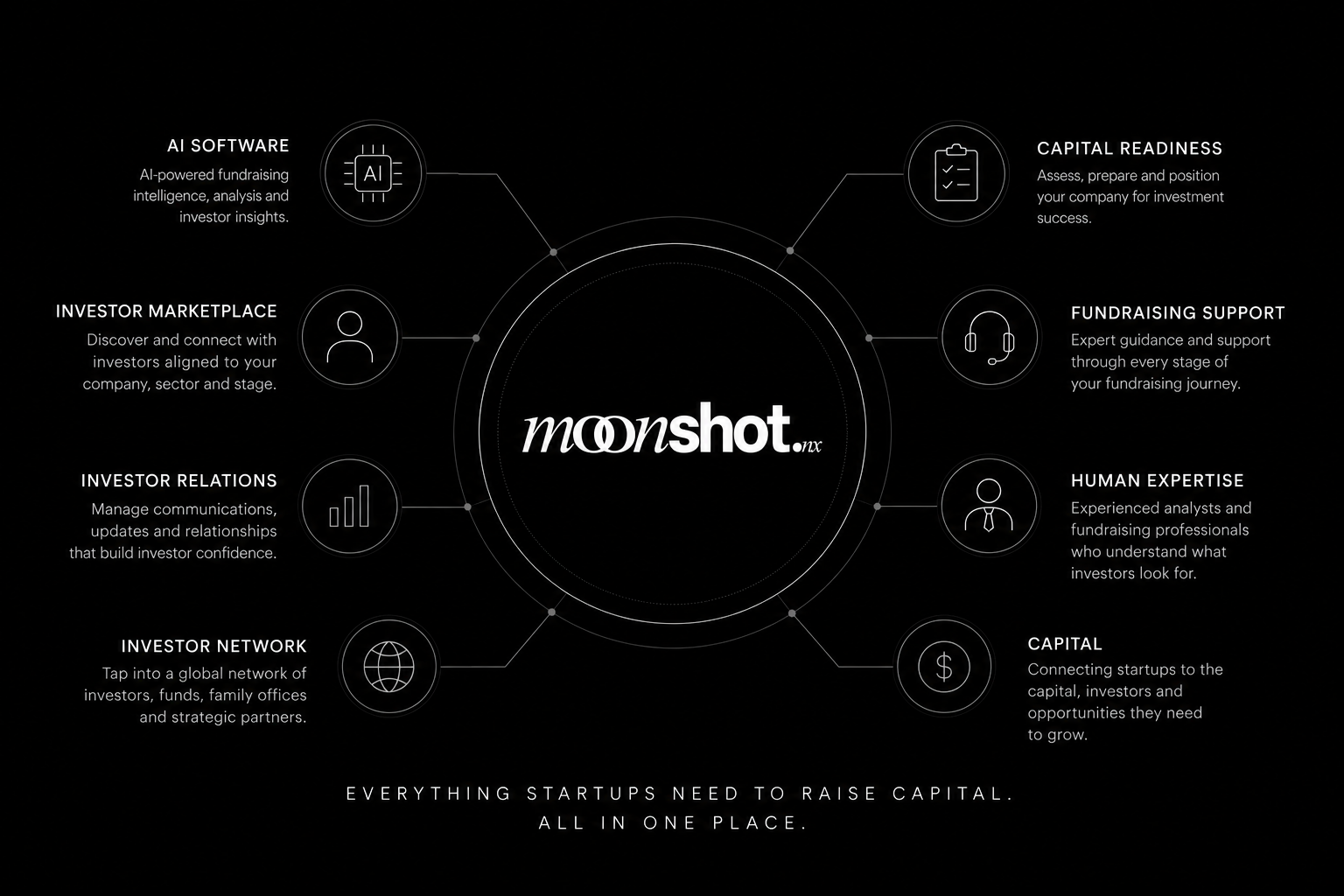
MoonshotNX combines AI, investor access, investor relations, fundraising infrastructure and human expertise into a single platform designed to help startups raise capital.
Built For The Entire Funding Journey
Assess
Understand your position and funding readiness.
Prepare
Strengthen your story, data and materials.
Connect
Find and engage the right investors.
Fundraise
Manage outreach, meetings and follow-ups.
Close
Navigate due diligence and close with confidence.
Grow
Build lasting investor relationships and grow faster.
Human-Led. Technology-Enabled.
Everything You Need To Raise Capital
MoonshotNX combines human-led Investor Relations, warm investor introductions, capital readiness, fundraising execution and ongoing investor engagement in one service. Our people manage the relationships and work directly with founders, supported by proprietary data, technology and embedded AI infrastructure.
Human-Led Investor Relations
Work directly with an experienced Investor Relations team throughout your fundraising journey.
Warm Investor Introductions
Connect with relevant investors through direct introductions made across the MoonshotNX global investor network.
Capital Readiness
Assess, prepare and position your company, raise and materials before entering investor conversations.
Investor Engagement
Build and manage investor relationships through communications, meetings, follow-ups and ongoing engagement.
Fundraising Support
Get hands-on guidance and support as your company moves from preparation into an active funding round.
Global Investor Network
Reach funds, family offices, angel investors, corporate investors and other capital providers across our global network.
Due Diligence
Prepare company information and documentation for investor review and the diligence process.
Investor Rooms
Present your company, materials and investment information in a structured environment built for investor review.
Investor Intelligence
Use investor data, market signals and fundraising intelligence to support targeting, positioning and decision-making.
Technology & AI Infrastructure
Proprietary data, automation and embedded AI support our teams with analysis, research, reporting and execution at scale.
Fundraising Is More Than Raising Capital.
Most founders spend years building products, acquiring customers and growing their businesses. However, successful startup fundraising requires more than a pitch deck or a single investor meeting.
Investors expect preparation, clear communication, responsiveness, transparency and ongoing engagement throughout the fundraising process. Whether a company is seeking venture capital, angel investment, venture debt, grant funding or other forms of growth capital, investor readiness and investor relations play a critical role in fundraising success. For many startups, managing investor communications, investor engagement and fundraising activities becomes a full-time responsibility alongside running the business.
MoonshotNX helps founders navigate that process through Investor Relations As A Service, providing investor relations support, fundraising guidance and investor readiness resources designed specifically for startups seeking capital.
Prepare
Get investor-ready with the right strategy and materials.
Communicate
Communicate clearly and professionally with investors.
Engage
Build relationships and maintain meaningful investor engagement.
Coordinate
Coordinate meetings, updates and investor interactions.
Raise
Navigate the capital formation process with confidence.
Explore Our Free Startup Tools, Calculators & Legal Templates
Explore the MoonshotNX founder toolkit. Access free startup calculators, fundraising planning tools, cap table builders, SAFE note calculators, valuation tools, runway planning resources and investor readiness assessments designed to help founders make better decisions and prepare for growth.
What You Get with MoonshotNX.
Investor Relations As A Service for startups seeking venture capital, angel investment, venture debt, grant funding and other forms of growth capital.
MoonshotNX provides founders with dedicated investor relations support, investor communications guidance, investor engagement coordination, meeting support and capital formation assistance through a simple monthly subscription. Whether you're preparing for a seed round, improving investor readiness, building investor visibility or actively fundraising, MoonshotNX helps startups navigate the journey from fundable to funded.
Investor Relations Support
Ongoing support throughout your fundraising journey from an experienced investor relations team.
Investor Visibility
Build a professional investor-facing presence that communicates your value and traction.
Investor Communications
Craft, manage and deliver clear, consistent communications to investors and stakeholders.
Investor Engagement
Engage the right investors and build relationships that create long-term value.
Meeting Coordination
Coordinate investor meetings and conversations so you can focus on building your business.
Capital Formation Support
Guidance and support through the fundraising process to help achieve stronger outcomes.
Built for Startups at Every Stage.
Pre-Seed
Laying the foundation and preparing for investor conversations.
Seed
Building investor visibility and raising your first round.
Growth
Managing investor relationships and driving growth.
Beyond
Continued support as you scale and raise future capital.
One System. Multiple Capital Paths. Structured For Speed.
Zero Equity. Zero Broker Commissions.
MoonshotNX brings fundraising preparation, investor engagement, and capital execution together in one place. Instead of navigating fragmented processes, founders work through a single environment designed to move companies toward funding. Powered by a 150,000-point intelligence framework and strengthened through expert human review, fundraising expertise, and investor-focused analysis.

Built To Standardise
MoonshotNX standardises how companies are prepared and presented before investor engagement begins.

Structured By Operators
Technology is combined with human review, fundraising experience, and investor-focused analysis.

Designed for Speed
Capital moves faster when companies are structured correctly. AI + Human review. One objective: helping companies get funded.
Why Founders Choose MoonshotNX.
Save Time
Focus on building your business, not managing investors.
Affordable
Enterprise-level investor relations support without the enterprise price.
Professional
Expert support that builds credibility and investor confidence.
Better Outcomes
Stronger relationships. Better conversations. Better fundraising outcomes.
Raising capital requires more than investor introductions. Founders need investor readiness, structured communications, credible materials, funding pathways and ongoing investor relations support.
MoonshotNX combines investor relations support, capital raising infrastructure, human review and market intelligence to help startups become fundable and funded.
250,000+
Global Investor Network
Investor access across angel networks, venture capital firms, family offices, corporate venture groups, private equity firms and institutional capital providers.
70,000+
Active Investment Organisations
Investment organisations evaluating opportunities across sectors, stages, geographies and capital mandates.
3
Funding Pathways
Support across equity capital, venture debt and non-dilutive grant funding pathways.
Global
Founder Ecosystem
Supporting founders building, growing and fundraising across multiple industries and markets.
Human + AI
Capital Intelligence
Structured company analysis, benchmarking, investor readiness insights and capital formation intelligence.
Reviewed
Human Oversight
Technology supported by experienced human review, fundraising expertise, investor-focused analysis and company evaluation.
Learn How Startup Fundraising Works.
Raising capital is one of the most complex challenges founders face. From investor readiness and startup valuation to due diligence, investor outreach, venture capital, angel investors and fundraising strategy, there are hundreds of decisions that can influence a funding outcome.
The MoonshotNX Knowledge Base contains practical guides, fundraising insights, investor education resources and startup funding articles designed to help founders better understand the fundraising process and navigate the path to capital.
One Simple Subscription.
Everything Included.
Professional Investor Relations As A Service for startups seeking capital, investor readiness support, investor engagement and fundraising guidance.
MoonshotNX IRaaS
$499
Per Month
Annual subscriptions receive a 10% discount.
FAQ
Startup Fundraising Questions
Answers to common questions about MoonshotNX, Investor Relations as a Service, warm investor introductions, capital readiness, fundraising support and how we work with founders raising capital.
What is MoonshotNX?
MoonshotNX is a human-led Investor Relations as a Service company for startups and growth companies raising capital. Our team works directly with founders on investor readiness, capital positioning, fundraising strategy, warm investor introductions, investor engagement, due diligence and progression toward closing a funding round.
Is MoonshotNX a software or AI fundraising platform?
No. MoonshotNX is a human-led Investor Relations as a Service company. Technology, proprietary data, automation and embedded AI are used throughout our infrastructure to support research, analysis, reporting and execution, but they do not replace our Investor Relations team, human investment review or the investor relationships at the centre of our service.
Do I work with real people at MoonshotNX?
Yes. Founders work directly with MoonshotNX Investor Relations, advisory and specialist teams throughout the process. Our technology supports our people behind the scenes, while company preparation, investment review, capital strategy, investor introductions, meetings, engagement and fundraising support remain human-led.
How does MoonshotNX help startups raise capital?
MoonshotNX supports founders from investor readiness through active fundraising. We help prepare and position the company, strengthen its investment proposition, review fundraising materials, develop capital strategy, make warm investor introductions, manage investor engagement, support meetings and follow-ups, prepare for due diligence and help move the raise toward closing.
How does MoonshotNX introduce founders to investors?
MoonshotNX makes warm introductions to relevant investors across our global network rather than simply giving founders access to a database or leaving them to conduct outreach alone. Our Investor Relations team supports the relationship before and after introduction, including investor communications, meetings, follow-ups, information requests and ongoing engagement.
What types of investors does MoonshotNX work with?
Our global investor network includes venture capital firms, angel investors, family offices, corporate investors, institutional investors and other capital providers across multiple sectors, stages and geographies. Investor engagement is based on the company, funding stage, capital requirements and relevant investment mandates.
How do I raise capital for my startup?
Raising capital requires more than finding a list of investors. Companies need a credible investment proposition, appropriate capital strategy, strong fundraising materials, investor readiness, targeted introductions, professional investor communications, consistent follow-up and preparation for due diligence. MoonshotNX works alongside founders throughout this process rather than leaving them to manage it alone.
How do I find investors for my startup?
The right investors depend on your company stage, sector, geography, raise size, traction and capital requirements. MoonshotNX uses investor intelligence, investment mandates and our global network to identify relevant capital sources, after which our Investor Relations team can make warm introductions and support the resulting investor relationships.
What does Investor Relations as a Service mean?
Investor Relations as a Service gives startups access to an experienced Investor Relations function without having to build a full internal IR team. MoonshotNX supports investor readiness, capital positioning, investor communications, warm introductions, meetings, follow-ups, investor engagement, reporting and fundraising execution as an ongoing service.
How does MoonshotNX use AI and technology?
MoonshotNX uses proprietary technology, data, automation and embedded AI as infrastructure supporting our human teams. These systems help with company analysis, benchmarking, investor research, fundraising intelligence, reporting and operational execution. AI is a supporting function within the MoonshotNX infrastructure; it does not replace human judgement, investment review, Investor Relations professionals or warm investor relationships.
What is capital readiness?
Capital readiness is the process of preparing a company to withstand investor scrutiny and enter a funding round from a stronger position. It includes the investment proposition, fundraising materials, valuation and capital strategy, financial information, market positioning, traction, due diligence documentation, investor communications and the company's overall ability to present a credible investment opportunity.
What happens before MoonshotNX introduces my company to investors?
Companies are assessed and prepared before entering active Investor Relations. MoonshotNX reviews investor readiness, fundraising positioning, company information and supporting materials so that weaknesses can be identified and addressed before investor engagement begins. Companies also progress through human review before moving into active investor introductions.
Does MoonshotNX guarantee that my company will raise capital?
No. No legitimate fundraising service can guarantee an investment outcome. Investment decisions are made independently by investors and depend on factors including the company, market, traction, valuation, terms, timing and investor mandate. MoonshotNX provides the preparation, Investor Relations support, warm introductions, infrastructure and fundraising execution designed to give qualified companies a stronger process and opportunity to raise capital.
What should be included in a startup data room?
A startup data room typically includes the pitch deck, company and corporate information, financial statements and forecasts, cap table, legal documents, commercial agreements, traction and KPI data, market information, intellectual property information and other materials investors may require during due diligence. MoonshotNX helps founders prepare and organise this information for investor review.
Is MoonshotNX a broker-dealer or investment bank?
No. MoonshotNX is not a broker-dealer, investment bank or placement agent. MoonshotNX provides Investor Relations as a Service, investor readiness and capital positioning support, investor introductions, fundraising infrastructure, due diligence preparation and ongoing investor engagement support.
Does MoonshotNX charge success fees or fundraising commissions?
No. MoonshotNX does not charge founders a percentage of the capital they raise. Our Investor Relations services are provided through a transparent fixed-fee model, allowing our team to support investor readiness, warm introductions, investor engagement and fundraising execution without taking a success-based percentage of the round.
Live Platform Telemetry.
Live platform activity across founders, investors, fundraising, diligence, and capital deployment within the MoonshotNX ecosystem.
Active Capital Raises.
MoonshotNX platform activity across active capital raises and investor diligence.
Active Investor Network.
Institutional, angel, family office and corporate capital connected to the MoonshotNX ecosystem.
Founder Activity.
Founder progress through capital readiness, investor access and funding execution.
Investor Activity.
Live investor participation, diligence flow, review activity and meeting demand across the MoonshotNX ecosystem.